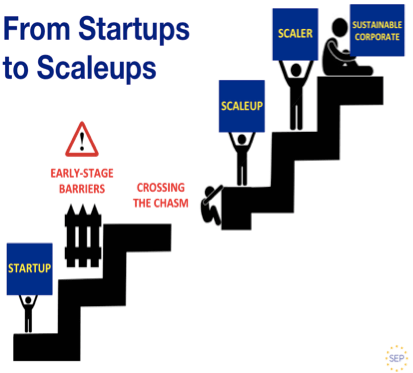
The Startup-Scaleup Journey: How to Take Your Business from Idea to Empire

Ready to Scale? A Startup’s Guide to Transitioning to a Thriving Scaleup

Starting a business is no easy feat, but it’s just the beginning of the journey. Once a startup has found its footing and proven its concept, the next step is often to scale the business and take it to the next level. But scaling a business isn’t just about growing bigger – it’s also about evolving and refining your operations to become more efficient and profitable.

So, how do you take a startup and turn it into a scaleup? Here are a few key things to consider:

  1. Define your target market and value proposition: Before you can start scaling your business, you need to have a clear understanding of who your target market is and what value you are offering them. This will help you to identify the most effective channels for reaching your audience and ensure that your marketing efforts are focused on the right people.
  1. Build a strong team: As your business grows, you will need a team of skilled and dedicated professionals to help you execute on your vision. It’s important to carefully consider who you bring on board and to create a culture that encourages collaboration and innovation.
  1. Streamline your processes: As you scale, you will need to find ways to become more efficient in order to meet the increasing demand for your products or services. This may involve automating certain tasks, standardizing processes, and finding ways to streamline your operations.
  1. Focus on profitability: Growth is important, but it’s not the only goal. As you scale your business, it’s important to focus on improving your bottom line and maximizing profitability. This may involve finding new revenue streams, cutting costs, or investing in technologies that can help you improve efficiency.
  1. Keep an eye on the competition: As you scale your business, you will inevitably face competition from other companies in your industry. It’s important to keep an eye on what your competitors are doing and to continually assess your own competitive advantage.

Scaling a business is no easy feat, but with careful planning and execution, it is possible to take a startup and turn it into a successful scaleup. By defining your target market, building a strong team, streamlining your processes, focusing on profitability, and keeping an eye on the competition, you can set your business on the path to long-term success.

Maximizing Meeting Efficiency: Tips for Avoiding Meeting Misery

From Death by Meetings to Meeting Magic: Secrets of Successful Meeting Management

Death by Meetings is a term used to describe the feeling of being overwhelmed and unproductive as a result of attending too many meetings. It’s a common problem in the workplace, and it can be frustrating and demotivating for employees. However, with a little planning and the right approach, it is possible to run meetings that are more effective and efficient.

Death by Meetings is a book written by Patrick Lencioni, a bestselling author and business consultant. In the book, Lencioni explores the common problems that plague meetings and offers practical solutions for making meetings more effective and efficient. According to Lencioni, most meetings suffer from one or more of the following problems: lack of clear purpose, lack of clear roles, and lack of clear agenda. He offers solutions for these problems, including establishing a clear purpose and goals for the meeting, inviting the right people and setting clear roles for attendees, and creating a clear agenda that covers all important topics. He also encourages leaders to follow up with action items to ensure that progress is being made and to hold attendees accountable.

Here are some additional tips for running better meetings using the principles of Death by Meetings and elements from Simon Sinek:

  1. Have a clear purpose: Before scheduling a meeting, it’s important to have a clear understanding of the purpose and goals of the meeting. This will help you determine if a meeting is necessary, and if so, who needs to be invited.
  2. Invite the right people: Invite only the people who are necessary for the meeting and have a specific role to play. This will help keep the meeting focused and prevent it from going off track.
  3. Set an agenda: An agenda helps to keep the meeting on track and ensures that all important topics are covered. Share the agenda in advance with attendees so they can come prepared.
  4. Start and end on time: Respect the time of your attendees by starting and ending the meeting on time. This shows that you value their time and helps to establish a sense of trust and respect.
  5. Keep the meeting focused: It’s easy for meetings to get sidetracked, so it’s important to stay focused on the main topics and avoid going off on tangents. Encourage participation, but remind attendees to stay on topic.
  6. Use Simon Sinek’s “Golden Circle” framework: Sinek’s framework encourages leaders to start with the “why,” then the “how,” and finally the “what.” By starting with the purpose and vision of the meeting, you can create a sense of connection and motivation for attendees.
  7. Follow up with action items: After the meeting, follow up with attendees to ensure that any action items have been completed. This helps to hold everyone accountable and ensures that progress is being made.

By following these tips, you can run meetings that are more effective and efficient, and help your team avoid “Death by Meetings.”

Navigating Complex Change: Tips for Leading Your Team Through Transition

Leading the Charge: Tips for Effectively Managing Complex Change in the Workplace

Change is a constant in the business world, and it’s not always easy to navigate. Complex change, in particular, can be challenging for both individuals and organizations as it often involves significant shifts in processes, structures, and ways of working.

As a leader, it’s your job to not only guide your team through complex change, but also to help them see the value in the change and motivate them to embrace it. Here are a few tips for leading people through complex change in the workplace:

  1. Communicate clearly and frequently. It’s important to keep your team informed about the changes happening within the organization. This includes providing information about why the change is necessary, what it will look like, and how it will impact the team. It’s also crucial to be transparent about any challenges or setbacks that may arise during the change process.
  2. Involve your team in the planning process. When people feel like they have a say in the direction of the organization, they are more likely to be invested in the change. Consider hosting open forums or brainstorming sessions where team members can provide input and ideas.
  3. Provide training and support. Complex change often requires people to learn new skills or adapt to new ways of working. It’s important to provide the necessary training and resources to ensure that your team is able to successfully navigate the change.
  4. Foster a positive, supportive culture. Change can be difficult, and it’s important to create a positive and supportive work environment where people feel comfortable and supported during the transition. This can involve things like offering additional resources or support, recognizing and celebrating successes, and providing opportunities for team building and collaboration.
  5. Emphasize the benefits of the change. While it’s important to be honest about the challenges that may come with complex change, it’s also crucial to highlight the benefits and opportunities that the change will bring. This can help motivate people to embrace the change and see it as an exciting evolution for the business.

Leading people through complex change isn’t always easy, but with clear communication, involvement, support, and a positive attitude, you can help your team navigate the transition and come out stronger on the other side.

The Power of Active Listening: How It Can Transform Your Team and Your Leadership

The Surprising Benefits of Active Listening: How It Can Boost Your Leadership and Team Performance

Active listening is a crucial skill for leaders to have. It involves fully paying attention to the person speaking, showing that you are listening through verbal and nonverbal cues, and actively trying to understand their perspective and message. This type of listening is valuable in a leadership role because it helps to build trust, foster open communication, and resolve conflicts.

One of the key benefits of active listening is that it helps to build trust between leaders and their team members. When leaders actively listen to their team, it demonstrates that they value their input and are willing to consider their perspective. This can create a sense of mutual respect and understanding, which is essential for building a strong and cohesive team.

Active listening is also important for fostering open communication within an organization. When team members feel that they are being heard and understood, they are more likely to speak up and share their ideas and concerns. This open communication is essential for problem-solving and decision-making, as it allows leaders to consider a wider range of perspectives and come up with the best solutions.

Another benefit of active listening is that it can help to resolve conflicts within a team. When leaders actively listen to both sides of a disagreement, they can better understand the root cause of the conflict and work to find a resolution that is fair and mutually beneficial. This can help to improve morale and productivity within the team.

In summary, active listening is an important skill for leaders to have as it helps to build trust, foster open communication, and resolve conflicts. By actively listening to their team, leaders can create a positive and collaborative work environment that promotes teamwork, creativity, and success. So, it is very important for leaders to be an active listener.

Lifehack Tip Of The Day Tricks Tips Tips And Tricks

Here are some tips on how to practice active listening:

  1. Focus your attention on the speaker: Make an effort to fully pay attention to the person speaking, and avoid distractions such as checking your phone or multitasking.
  2. Show that you are listening: Use verbal and nonverbal cues to demonstrate that you are engaged in the conversation. This can include nodding your head, making eye contact, and asking clarifying questions.
  3. Avoid interrupting: Let the speaker finish their thought before jumping in with your own perspective.
  4. Reflect on what is being said: Paraphrase or summarize what the speaker is saying to demonstrate that you understand their message.
  5. Empathize with the speaker: Try to see things from the speaker’s perspective and show that you are understanding their feelings and experiences.
  6. Stay open-minded: Avoid making assumptions or jumping to conclusions before fully understanding the speaker’s perspective.
  7. By following these tips, you can practice active listening and create a more positive and productive communication dynamic with your team.

Strategic Thinking: The Key to Long-Term Success for Leaders

Navigating the Future with Strategic Thinking: A Leader’s Playbook

Strategic thinking is a crucial skill for leaders in any organization. It involves the ability to analyze and understand the current and future state of a company or organization, identify opportunities and challenges, and develop and implement plans to achieve long-term goals. In this blog, we will discuss some key strategies that leaders can use to improve their strategic thinking skills and make more informed, effective decisions for their organizations.

  1. Define your organization’s mission and goals. The first step in strategic thinking is to have a clear understanding of your organization’s purpose and what it is trying to achieve. This will provide a framework for all decision-making and help ensure that your organization stays focused on its long-term objectives.
  2. Analyze the current situation. Once you have a clear understanding of your organization’s mission and goals, it’s important to take a step back and assess the current state of your organization. This includes analyzing your internal and external environments, identifying strengths and weaknesses, and identifying any opportunities or threats that may impact your organization’s ability to achieve its goals.
  3. Identify potential solutions and options. Once you have a good understanding of the current situation, it’s time to start brainstorming potential solutions and options. This might involve considering different courses of action, analyzing the pros and cons of each option, and identifying any potential risks or challenges.
  4. Make informed decisions. After you have identified a range of potential solutions and options, it’s important to carefully evaluate each one and make informed decisions based on all available information. This might involve seeking input and feedback from other team members or stakeholders, conducting additional research, or using tools like cost-benefit analysis to assess the potential impact of each option.
  5. Monitor and adjust. Strategic thinking is an ongoing process, and it’s important to continuously monitor and adjust your plans as necessary. This might involve reassessing your organization’s mission and goals, reevaluating the current situation, or adjusting your plans based on new developments or changing circumstances.

In conclusion, strategic thinking is a vital skill for leaders in any organization. By defining your organization’s mission and goals, analyzing the current situation, identifying potential solutions and options, making informed decisions, and continuously monitoring and adjusting your plans, you can effectively guide your organization towards long-term success.

The Leader’s Decision-Making Playbook: Essential Strategies for Success

Mastering the Art of Decision-Making: A Leader’s Guide

Decision-making is a crucial part of being a leader. Whether you are leading a team, a company, or a community, the decisions you make can have a significant impact on the direction and success of your organization. As a leader, it is important to approach decision-making with a clear and thoughtful process to ensure that you are making informed and effective choices.

Here are some key considerations for making good decisions as a leader:

  1. Clearly define the problem or decision at hand. Before you can make a decision, you need to understand the issue or challenge you are facing. Take the time to thoroughly analyze the situation and gather all the necessary information to make an informed decision.
  2. Involve the right people in the decision-making process. Depending on the nature of the decision, it may be appropriate to involve different stakeholders in the process. This could include team members, customers, or external experts. By involving the right people, you can benefit from diverse perspectives and ensure that all relevant viewpoints are considered.
  3. Consider the potential consequences of each option. When making a decision, it is important to consider the potential outcomes of each option. Think about how the decision will impact the organization, its stakeholders, and the broader community.
  4. Use a systematic approach. There are various approaches to decision-making, such as the pros and cons method or decision trees. Using a systematic approach can help you weigh the pros and cons of each option and make a more informed decision.
  5. Trust your instincts, but also be open to new ideas. As a leader, you have a wealth of experience and knowledge that can inform your decisions. However, it is also important to be open to new ideas and approaches. Consider seeking out fresh perspectives and being open to alternative viewpoints.
  6. Communicate the decision effectively. Once you have made a decision, it is important to clearly communicate your reasoning to your team and other stakeholders. This can help to build trust and ensure that everyone is aligned and working towards the same goals.

Decision-making can be challenging, but by following a clear and thoughtful process, you can make informed and effective choices as a leader. Remember to define the problem, involve the right people, consider the consequences of each option, use a systematic approach, trust your instincts and be open to new ideas, and communicate the decision effectively.

Ready, Set, Go! The Essential Steps to Starting a Business

The Top Things You Need to Know Before Starting a Business

Starting a business can be a daunting task, but it can also be an exciting and rewarding experience. Whether you’re starting a small business or a larger enterprise, there are a few key steps that you’ll need to follow to ensure success. Here’s a basic guide to getting your business off the ground:

  1. Define your business idea: Before you start a business, you need to have a clear idea of what you want to do. Consider your skills, interests, and experience, and think about what kind of product or service you can offer that will be in demand.
  2. Conduct market research: Once you have a business idea, it’s important to do some research to see if there is a market for it. Look for data on the size of the market, potential competitors, and the needs and preferences of your target customers.
  3. Create a business plan: A business plan is a detailed roadmap that outlines your business goals, strategies, and resources. It should include a description of your product or service, your target market, your financial projections, and your marketing and sales plan.
  4. Choose a business structure: There are several different business structures to choose from, including sole proprietorship, partnership, corporation, and Limited Liability Company (LTD). Each has its own benefits and drawbacks, so it’s important to consider which one is right for your business.
  5. Register your business: Depending on your business structure and location, you may need to register your business with the government. This typically involves obtaining a business license or permit, and possibly registering with the state or federal government.
  6. Secure financing: Starting a business often requires a significant amount of capital. You may need to secure financing through a loan, investment, or crowdfunding campaign.
  7. Build a team: Depending on the size and scope of your business, you may need to hire employees or contractors to help you get off the ground. As you grow, you’ll need to put systems in place to manage and motivate your team.
  8. Launch and market your business: Once you have everything in place, it’s time to launch your business and start marketing it to potential customers. This may involve creating a website, setting up social media accounts, and developing a marketing plan to get the word out about your product or service.

Starting a business can be challenging, but with careful planning and hard work, it’s definitely possible to achieve success. With these basic steps in mind, you’ll be well on your way to building a successful business.

Defining and Refining Your Business Idea

Starting a business is an exciting and potentially lucrative endeavor, but it’s important to carefully define and refine your business idea before you invest a lot of time and resources into it. By using a variety of methods, you can ensure that your business idea is well-thought-out, viable, and likely to succeed.

There are several methods that can be used to help define and refine a business idea. Some of these methods include:

  1. Brainstorming: This is a creative process that involves generating as many ideas as possible in a short period of time. It can be done individually or with a group of people.
  2. SWOT analysis: This method involves identifying the strengths, weaknesses, opportunities, and threats of a business idea.
  3. Customer research: Conducting market research and gathering feedback from potential customers can help refine a business idea and ensure that it addresses a real need or desire.
  4. Lean planning: This method involves creating a simple, one-page business plan that outlines the key elements of the business idea, including the target market, value proposition, and proposed solution.
  5. Prototyping: Building a prototype or a minimal viable product (MVP) can help test and validate a business idea, as well as gather feedback from potential customers.
  6. Pitch practice: Practicing your pitch and presenting it to others can help clarify and refine your business idea, as well as give you valuable feedback and suggestions.

Conducting Market Research for Your Startup

Market research is an essential step in the process of starting a business. By gathering information about your target market and competitors, you can gain valuable insights that will help you develop and refine your business idea, marketing strategies, and operations.

  1. Determine your research objective: What do you want to learn through your market research? Having a clear objective will help guide your research and ensure that you gather the information you need.
  2. Choose your research methods: There are many ways to gather data for your market research, including primary and secondary methods. Primary methods involve collecting original data through methods such as surveys, focus groups, and interviews. Secondary methods involve gathering data from existing sources, such as industry reports, government statistics, and online databases.
  3. Create a research plan: Once you have determined your research objective and chosen your methods, you can create a plan that outlines the steps you will take to gather and analyze the data.
  4. Gather data: This involves implementing your research plan and collecting the data you need. For example, you might create a survey and distribute it to your target market, or gather data from online sources such as industry reports and government statistics.
  5. Analyze the data: Once you have gathered your data, you will need to analyze it to extract useful insights. This may involve using statistical tools to analyze the data, or simply organizing and reviewing the information you have collected.
  6. Use the insights to inform your business decisions: The insights you gather through your market research should be used to inform your business decisions. For example, you might use the data to refine your business idea, develop marketing strategies, or identify opportunities for growth.

By conducting thorough market research, you can gain a deeper understanding of your target market and identify opportunities for your startup. This information can help you make informed decisions and increase your chances of success.

The Power of Good Communication: A Leader’s Secret Weapon

Why Communication is Crucial for Effective Teams

Good communication is an essential skill for any leader. It is the key to building strong relationships, motivating employees, and achieving success. Effective communication helps leaders to understand their team’s needs, create a shared vision, and ensure that everyone is on the same page. In this blog post, we’ll explore the power of good communication and how it can be a leader’s secret weapon.

What are the most effective ways to communicate?

Effective communication as a leader includes being clear and concise in your messaging, actively listening to and engaging with your team, leading by example, and adapting your communication style to the audience and situation. Communication is an essential part of any successful relationship, whether it be personal or professional. The most effective ways to communicate depend on the situation and the people involved, but there are some general tips that can help ensure effective communication.

First, be clear and direct. Make sure that your message is clear and easy to understand. Avoid using jargon or technical language that the other person may not understand.

Second, be respectful and open-minded. Listen to what the other person has to say and be willing to compromise. Respect their opinion and be open to different points of view.

Third, be patient. Communication can take time, so be patient and allow the other person to express their thoughts and feelings.

Finally, be honest and authentic. Be honest about your feelings and opinions and be authentic in your communication. This will help build trust and understanding between you and the other person. By following these tips, you can ensure that your communication is effective and that you are able to get your message across in the best way possible. Building trust and fostering open and honest communication within your team can also be crucial in ensuring effective communication. Additionally, being able to effectively communicate the vision and goals of the organization can help to align and motivate team members.

What are the challenges of communicating in a virtual environment?

As a leader in a virtual environment, it is essential to be clear and concise in your messaging, actively listen to and engage with your team, lead by example, and adapt your communication style to the audience and situation. However, virtual communication can present a number of challenges, such as the lack of face-to-face contact, difficulty in interpreting messages, technical issues, and time consuming conversations. To overcome these challenges, it is important to have clear communication protocols, be aware of time zone differences, and make an effort to build and maintain personal connections with your team. Additionally, ensure you have a good internet connection, use video conferencing, and have a dedicated space to focus on the conversation.

How can we better understand the messages we receive?

One of the best ways to better understand the messages we receive is to take the time to really think about what is being said. Ask yourself questions like: What is the main point of this message? What is the context? What is the speaker’s intention? Doing this can help you to better interpret the message and gain a better understanding of what is being said. Additionally, it can be helpful to talk to the sender of the message to get clarification if needed. This can help to ensure that you have a full understanding of the message and can respond appropriately.

Here are some tips for improving your leadership communication skills:

  • Be clear and concise: Make sure you are clear and concise in your communication. Avoid using jargon or technical language that may be confusing to your team.
  • Be an active listener: As a leader, it’s important to not only talk, but to also listen to your team members. Make sure to provide them with a chance to express themselves and pay close attention to what they are saying. Doing so will help build a sense of trust and respect in your group.
  • Encourage open communication: Encourage open and honest communication within your team. This can help create a positive and supportive team culture where everyone feels comfortable sharing their ideas and concerns.
  • Use different communication channels: Different people have different communication preferences. Some people may prefer face-to-face communication, while others may prefer email or messaging. Make sure you are open to using different communication channels to reach all team members.
  • Practice empathy: As a leader, it is important to try to see things from your team’s perspective. Empathy helps you better understand and connect with your team, which can improve communication and foster a positive team culture.

By following these tips, you can improve your leadership communication skills and become a more effective leader.

Here are some examples of the best business communicators of our time:

Gaining knowledge from the top business communicators can be a great source of motivation and guidance for those looking to enhance their communication abilities. By studying their methods, strategies, and techniques, we can gain understanding of what makes them successful and apply it to our own communication. Additionally, we can learn to be more genuine, open, and confident in our communication by observing their style, which can help us to build relationships and gain trust.

  • Steve Jobs: Steve Jobs, the co-founder and former CEO of Apple, was known for his ability to communicate his vision and passion for technology in a way that inspired and motivated his team. He was able to convey complex technical concepts in simple terms, making them accessible and exciting to a wide audience. Additionally, he used storytelling and presentation skills to captivate and engage his audience, making them believe in his vision and products.
  • Oprah Winfrey: Oprah Winfrey is a well-known media personality and business leader known for her ability to connect with her audience on a personal level. She is an expert in active listening and is able to create a sense of trust and authenticity with her audience, which helped her to build one of the most successful talk shows in history.
  • Richard Branson: Richard Branson, the founder of Virgin Group, is known for his ability to communicate the company’s values and mission in a way that inspires and motivates his team. He is a great storyteller, and his charismatic personality helped him to connect with his audience and build a strong brand.
  • Jack Welch: Jack Welch, the former CEO of General Electric, was known for his ability to communicate effectively with his team and shareholders. He was able to communicate complex business strategies in a way that was easy to understand, and he was able to inspire and motivate his team to achieve their goals.
  • Elon Musk: Elon Musk, the CEO of Tesla and SpaceX, is a great communicator. He is able to explain complex technical concepts in simple terms, and he is able to inspire and motivate his team to work towards ambitious goals. He also uses social media to communicate directly with his customers and shareholders, creating a sense of transparency and trust.

These examples of leaders are known for their unique communication skills and ability to convey their message in a way that inspires and motivates their team. They use storytelling, charisma, transparency, and simplicity as a tool to engage and connect with their audience. They also demonstrate that effective communication is not only what you say but also how you say it, and how you listen to the others.

Closing Summary

To sum up, successful communication is a must-have ability for any leader. It is essential to be able to communicate clearly and concisely, to listen actively, to lead by example, and to adjust to the audience and situation. Additionally, it is important to create trust and promote open and honest communication within the team. A leader who can effectively communicate the objectives of the organization can help to align and motivate the team. However, when communicating virtually, leaders may encounter further difficulties such as lack of nonverbal cues, technical problems, time zone differences, and limited face-to-face contact. To overcome these issues, it is necessary to set up clear communication protocols, be aware of time zone differences, and make an effort to build and maintain personal connections with the team through virtual communication. All in all, good communication is a powerful tool for leaders, and with the right skills and strategies, leaders can effectively communicate and lead their teams, even in a virtual setting.

Coaching vs. Mentoring: Which is Right for You?

Exploring the Differences Between Coaching and Mentorship

Coaching and mentoring are two approaches that are often used to help individuals develop and grow in their personal and professional lives. While they may have some similarities, they are distinct and have their own unique benefits. 

In this blog, we will explore the differences between coaching and mentoring.

First, let’s define each term:

Coaching: Coaching is a professional relationship in which a coach helps an individual or group develop specific skills, knowledge, and behaviours. The coach helps the individual identify areas for improvement, sets goals and creates a plan to achieve those goals, and provides support and accountability as the individual works towards achieving those goals. The focus is very much on the person, not the problem.

Mentoring: Mentoring is a relationship in which an experienced individual, the mentor, shares their knowledge, skills, and experience with a less experienced individual, the mentee. The mentor provides guidance and support to the mentee, helping them navigate their career and personal development.

Coaching focuses more on personal awareness and self-reflection, whereas Mentorship is about providing guidance and suggestions on the path.

Why Leadership Coaching is important?

Leadership coaching is important because it helps leaders to become more effective in their roles. It allows them to identify and address any weaknesses or areas for improvement, and to develop new skills and strategies that will enable them to lead their teams more effectively.

Coaching can help leaders to:

  • Enhance their self-awareness: Coaching helps leaders to better understand their own strengths, weaknesses, values, and motivations, which can lead to more authentic and effective leadership. It gives the coachee time to reflect and think about their emotional state when making decisions and taking action.
  • Improve communication and interpersonal skills: Coaching can help leaders to communicate more effectively with their team members and stakeholders, and to build stronger, more productive relationships. It also focuses on the person being coached and supports the practice of Active Listening and learning from others.
  • Increase their ability to manage and motivate teams: Coaching can provide leaders with the tools and strategies they need to effectively manage and motivate their teams, leading to higher levels of engagement and productivity. The majority of people want to feel in control and thus a coaching model can support their thinking around their thoughts and actions.
  • Develop a growth mindset: Coaching encourages leaders to embrace a growth mindset, which is the belief that personal and professional development is ongoing and that there is always room for improvement. Through coaching, there is a large amount of reflection that takes place, often helping the coach learn and grow from their conversations. 

Overall, leadership coaching can help leaders to become more effective, confident, and successful in their roles, which in turn can lead to stronger, more sustainable business results. Our recommendation is for senior leaders should focus on Coaching over Mentorship as they progress higher in an organisation.

What qualities make a successful coach or mentor?

Coaching and mentoring are powerful tools that can help individuals and organizations achieve their goals and develop their potential. However, not all coaches and mentors are created equal. In order to be truly successful in these roles, there are certain qualities that are essential.

First and foremost, a successful coach or mentor must have strong communication skills. This includes the ability to effectively listen to and understand the perspectives and experiences of others, as well as the ability to clearly and effectively convey information and guidance. The art of Active Listening takes years of practice and dedication to perfect and is often the first thing to go when teams and leaders are under pressure. 

Empathy is another important quality for a successful coach or mentor. This means being able to understand and relate to the emotions and challenges of the individuals they are working with. This helps to build trust and rapport, which is essential for the coaching or mentoring relationship to be successful. Seeing the world from multiple views can help you strengthen your strategic thinking and business execution. 

Patience is another key quality for a coach or mentor. Coaching and mentoring can be a slow process, and it is important for a coach or mentor to be able to be patient with their clients or mentees as they work through their challenges and make progress. Often we want to rush the process and tell someone the answer that we think is correct, skipping a huge amount of learning and personal development that takes place during the conversation.

In addition to strong communication skills and empathy, a successful coach or mentor should also have a high level of knowledge and expertise in the subject matter or skills they are teaching. This will enable them to provide valuable insights and advice that can help their clients or mentees to achieve their goals. Using certified coaches is extremely important to ensure best practices are followed and practiced within the organisation. There are several groups and certifications that help support the certification of coaches – our practices follows the ICF standards for Coaching

Adaptability is another important quality for a coach or mentor. Each individual is unique, and a successful coach or mentor should be able to adapt their approach to the unique needs and learning styles of each individual they work with.

positive attitude is also essential for a coach or mentor. They should be able to inspire and motivate others to achieve their goals and overcome obstacles.

Confidentiality is also an important quality for a coach or mentor. They should be able to keep the information shared by the mentee or client confidential unless there is a legal or ethical reason for disclosing it.

Lastly, a coach or mentor should maintain a high level of professionalism. This includes setting boundaries, and maintaining a high ethical standard.

As a provider of leadership coaching services, we understand the importance of these qualities and we strive to provide our clients with a coaching experience In conclusion, a successful coach or mentor must possess strong communication skills, empathy, patience, knowledge, adaptability, positive attitude, confidentiality and professionalism. These qualities are essential for building trust, rapport, and effectively guiding individuals to achieve their goals and reach their full potential.

What are the benefits of having a coach or mentor?

Coaching and mentoring are powerful tools that can help individuals and organizations achieve their goals and reach their full potential. In today’s fast-paced and competitive business world, having a coach or mentor can provide a range of benefits that can help you improve your leadership skills, increase your productivity, and achieve success.

One of the key benefits of having a coach or mentor is that they can provide you with valuable insights and perspectives that can help you see things from a different angle. A coach or mentor can help you identify your strengths and weaknesses, and provide you with the guidance and support you need to overcome obstacles and achieve your goals.

Another benefit of having a coach or mentor is that they can provide you with the accountability and motivation you need to stay on track and achieve your objectives. A coach or mentor can help you set clear goals, create a plan of action, and hold you accountable for your progress. They can also provide you with the encouragement and support you need to stay motivated and focused on achieving your goals.

Coaching and mentoring can also help you improve your leadership skills and increase your effectiveness as a leader. A coach or mentor can help you develop your communication, problem-solving, and decision-making skills, and provide you with the tools you need to lead your team effectively.

In addition, having a coach or mentor can also help you to increase your productivity and efficiency. A coach or mentor can help you identify and eliminate time-wasters, set priorities, and create systems that can help you work more efficiently.

Overall, the benefits of having a coach or mentor are numerous and can help individuals and organizations achieve success in their personal and professional lives.

How can coaching and mentoring help to develop a successful organizational culture?

Coaching and mentoring can be powerful tools for developing a successful organizational culture. Coaching helps employees to identify and develop their strengths, while mentoring provides guidance and support to help employees reach their career goals. By providing these resources, organizations can create an environment of trust and collaboration, which can lead to increased productivity, improved morale, and better communication. Additionally, coaching and mentoring can help to foster a culture of innovation and creativity, as employees are encouraged to think outside the box and come up with new ideas. Ultimately, these resources can help organizations to create a culture of success, where employees feel valued and empowered to reach their full potential.

Leading the Way: Successful Business Leaders Who Rely on Coaching

There are many experienced business leaders who have publicly endorsed the use of coaching to help them improve as leaders and drive better business results. Here are a few examples:

  1. Howard Schultz, former CEO of Starbucks: Schultz has credited his coach with helping him to become a more effective leader and to navigate the challenges of growing Starbucks into a global brand.
  2. Jim Collins, management consultant and author: Collins has written extensively about the importance of coaching for leaders, and has said that his own coaches have played a vital role in his own personal and professional development.
  3. Sheryl Sandberg, COO of Facebook: Sandberg has spoken publicly about the role that coaching has played in helping her to develop as a leader and to navigate the challenges of her career.
  4. Eric Schmidt, former CEO of Google: Schmidt has said that he has benefited greatly from the guidance of his coaches, and has encouraged other leaders to seek out coaching as a way to improve their skills and effectiveness.

These are just a few examples of the many experienced business leaders who have found coaching to be a valuable tool for personal and professional development.

In Summary

The benefits of having a coach or mentor are numerous and can help individuals and organizations achieve success in their personal and professional lives. A coach can provide valuable insights, guidance, and support that can help you overcome obstacles, achieve your goals, and reach your full potential. A coach can also help you improve your leadership skills, increase your productivity, and achieve success. It’s important to mention that a fully trained coach can provide even greater value as they have the knowledge, tools, and techniques to support you in a more comprehensive way. With the right coach by your side, you can unlock your full potential and achieve success in all areas of your life. If you are ready to invest in your growth and development, I invite you to contact the team to learn more about our coaching services.

Why Your Vision Statement is the Key to Business Success

Don’t Let Your Business Become a Statistic | The Consequences of Not Having a Vision Statement

One model that can help to understand the importance of a vision and mission is Patrick Lencioni’s model of organizational health. According to Lencioni, a healthy organization has three key elements: a cohesive leadership team, a clear direction, and a healthy culture. A clear vision and mission contribute to all three of these elements.

Having a shared vision and mission can help to bring the leadership team together and foster a sense of unity. When everyone is working towards the same goal, it builds trust and cooperation, resulting in a stronger and more effective leadership team.

A clear vision and mission provide a clear direction for the organization. By having a clear understanding of what the organization is trying to achieve, employees at all levels can work towards this common goal. This helps to align the efforts of everyone in the organization, ensuring that everyone is working towards the same objectives.

A clear vision and mission can help to create a healthy culture within the organization. When everyone is working towards a shared goal and purpose, it creates a sense of meaning and belonging. This can help to create a positive and motivated workforce, leading to increased productivity and overall success for the organization.

What is a Vision Statement?

Having a clear and well-defined plan for your business is essential for success. A strategic vision statement provides direction and focus, helping you to make decisions that will lead to the growth and success of your business. This statement should be inspiring and reflect the values and impact that are important to the business. It should be a long-term, aspirational statement that is intended to motivate and guide the organization’s actions and decisions over time.

A vision statement should be aspirational and motivating, embodying the values and impact that are essential to the business. It is typically a long-term, inspiring declaration that is meant to motivate and direct the organization’s behaviour and choices in the future.

What is the difference between a Mission Statement and Vision Statement?

A vision statement and a mission statement are both important elements of a company’s overall strategy, but they serve different purposes.

A vision statement is a statement of an organization’s overarching goals and aspirations, and it is intended to provide direction and inspiration for the organization. It is often considered a long-term, aspirational statement that is intended to inspire and guide the organization’s actions and decisions over time. A vision statement is typically created by an organization’s leadership and is intended to align the efforts of all members of the organization towards achieving a common goal.

A mission statement, on the other hand, is a statement of an organization’s purpose and the specific goals it aims to achieve in order to fulfil its purpose. It is intended to provide a framework for decision-making and to guide the actions of the organization. A mission statement is typically created by an organization’s leadership and is intended to communicate the organization’s values and goals to its stakeholders.

In summary, a vision statement is a statement about the future, about where the organization wants to be, and a mission statement is a statement about the present, about what the organization does now and what it’s set up to do. While a vision statement is more about the big picture and long-term aspirations, a mission statement is more about the day-to-day actions and the specific goals that the organization aims to achieve in order to fulfil its purpose.

What are the best practices for writing a Vision Statement?

Writing a vision statement can be a challenging task, but by following these best practices, you can create a statement that is clear, inspiring, and effective in guiding your organization’s direction and decision-making.

  • Keep it simple: A vision statement should be easy to understand and communicate. Avoid using jargon or complex language that will make it difficult for people to understand.
  • Make it aspirational: A vision statement should be ambitious and inspire people to work towards achieving it. It should reflect the values and impact that are important to the business.
  • Make it specific: A vision statement should be specific and provide a clear direction for the organization. It should be measurable, so you can track the progress and make adjustments as necessary.
  • Make it aligned with your organization’s values: A vision statement should be aligned with the values of the organization and reflect the impact that the organization wants to make on the world.
  • Involve your team: Involve your team in the process of creating a vision statement. This will help to ensure that the statement is aligned with the team’s values and goals, and it will also encourage buy-in and commitment from the team.
  • Make it actionable: The vision statement should be actionable, it should provide a clear path for the organization to follow and guide its decision-making.
  • Review and update regularly: Review and update your vision statement regularly to ensure that it remains relevant and aligned with the organization’s goals and values.

By following these best practices, you can create a vision statement that is clear, inspiring, and effective in guiding your organization’s direction and decision-making. A powerful vision statement should be something that inspires and guides the organization towards a common goal and aligns the team’s efforts towards achieving it.

How do you use your business vision to motivate and inspire your team?

It is essential to have a well-defined vision for your business in order to set and reach goals, as well as motivate your team. A vision statement should be a succinct representation of the future you wish to create for your company. It should be motivating and provide guidance and focus. When formulating your vision statement, think about the objectives you want to accomplish, how you want to be perceived by customers, and the values that are important to your business. Additionally, consider the influence you want to have on the world.

Once you have a clear idea of what you want to accomplish, make sure to share it with your team. Explain the vision in detail and explain how it can be achieved. Use the vision statement to motivate and encourage your team by setting objectives that are in line with it. Make sure your team understands how their work contributes to the larger picture and how their individual efforts can help the organization reach its goals.

Here are a few ways you can use your business vision to motivate and inspire your team:

  • Communicate your vision clearly: Make sure your team understands your vision and how it aligns with their work. Share your vision with them in a way that is easy for them to understand, and make sure it is communicated consistently throughout your organization.
  • Use your vision to set goals: Your vision should be the foundation for your business goals. Use it to set specific, measurable, and achievable goals for your team, and help them understand how their work contributes to achieving those goals.
  • Lead by example: As a leader, it is important to model the behaviour you want to see in your team. If you are passionate and committed to your vision, it will be contagious and will inspire your team to do the same.
  • Recognize and reward success: Recognizing and rewarding your team’s successes not only acknowledges their hard work, but it also helps to keep your vision top-of-mind. When people see that their work is appreciated and valued, they will be more motivated to continue working towards achieving your vision.
  • Celebrate milestones: Achieving milestones is a great way to keep your team motivated and inspired. Celebrating these milestones together as a team can help to remind everyone of the progress they’ve made and how they’re contributing to achieving the vision.
  • Empower your team: Give your team the autonomy and resources they need to achieve your vision. Trust them, and show them that you believe in their ability to make a difference.
  • Continuously evaluate: Continuously evaluate and adjust your vision and goals as necessary. This helps to ensure that your vision remains relevant and that your team remains motivated and inspired to work towards it.

To wrap up, having a well-defined and convincing vision for your company is an essential element for motivating and energizing your staff. By expressing it clearly, establishing objectives, demonstrating leadership, acknowledging and rewarding accomplishments, giving your team authority, and regularly assessing, you can make sure that your team is completely devoted to reaching your vision.

What strategies do you use to stay focused on your business vision?

Having a clear vision for your business is essential for success. It helps you stay focused on what you want to achieve and provides a roadmap for the future. To stay focused on your business vision, there are a few strategies you can use.

First, create a mission statement and vision statement. A mission statement is a brief description of your business’s purpose and goals. A vision statement is a more detailed description of what you want your business to become in the future. Both of these statements should be clear, concise, and inspiring.

Second, use your mission and vision statements to guide your decisions. Whenever you’re making a decision, ask yourself if it’s in line with your vision. If not, it’s probably not the right decision for your business.

Third, communicate your mission and vision statements to your team. Make sure everyone is on the same page and understands the direction you’re heading in. This will help ensure everyone is working towards the same goals.

Finally, stay connected with your customers. Listen to their feedback and use it to inform your decisions. This will help ensure your vision is in line with what your customers want and need.

By following these strategies, you can stay focused on your business vision and ensure your business is heading in the right direction.

How do you measure progress towards achieving your business vision?

Measuring progress towards achieving your business vision is essential for any successful business. A vision statement is a clear and concise description of the long-term goals of your business, and it serves as a guide to help you make decisions and stay focused on the big picture. To measure progress towards achieving your vision, it’s important to have a clear mission statement that outlines the purpose of your business and what you hope to achieve. Additionally, you should have a set of measurable goals that are aligned with your vision and mission statements. These goals should be specific, measurable, achievable, relevant, and time-bound (SMART).

Once you have your mission and vision statements and SMART goals in place, you can measure progress towards achieving your vision. This can be done by tracking key performance indicators (KPIs) such as customer satisfaction, revenue growth, and employee engagement. You can also track progress by measuring how well your brand is resonating with customers and how well your products and services are meeting their needs. By tracking these metrics, you can get a better understanding of how close you are to achieving your vision and make adjustments as needed.

In conclusion, having a clear vision and mission is critical to the success of any business. It helps to create a cohesive leadership team, provides a clear direction for the organization, and promotes a healthy culture. Without a clear vision and mission, a business may lack focus and direction, leading to confusion and ultimately, failure.

Closing Summary

A vision statement is critical to a business because it provides direction and focus for the organization. It serves as a compass that helps to guide decision-making and keep the team aligned and working towards a common goal. A well-crafted vision statement should be aspirational and inspiring, and it should reflect the values and impact that are important to the business.

There are many real-world examples of firms that have amazing vision statements that inspire people. One example is Patagonia, a clothing company that has a vision statement of “We’re in business to save our home planet.” This statement not only communicates their commitment to environmental sustainability but also inspires customers and employees to take action and make a positive impact on the world.

Another example is Google, with its vision statement “To organize the world’s information and make it universally accessible and useful.” This statement reflects the company’s mission to make information accessible to everyone, and it inspires employees to work towards this goal and continue to innovate and improve their products.

In summary, a vision statement is an essential component of a successful business, as it serves to direct the organization’s activities and motivate people to strive for a shared purpose. The aforementioned companies are prime illustrations of how a powerful vision statement can motivate people to take action and have a positive effect on the world.